Why didn’t my cookies spread? Start with the flour
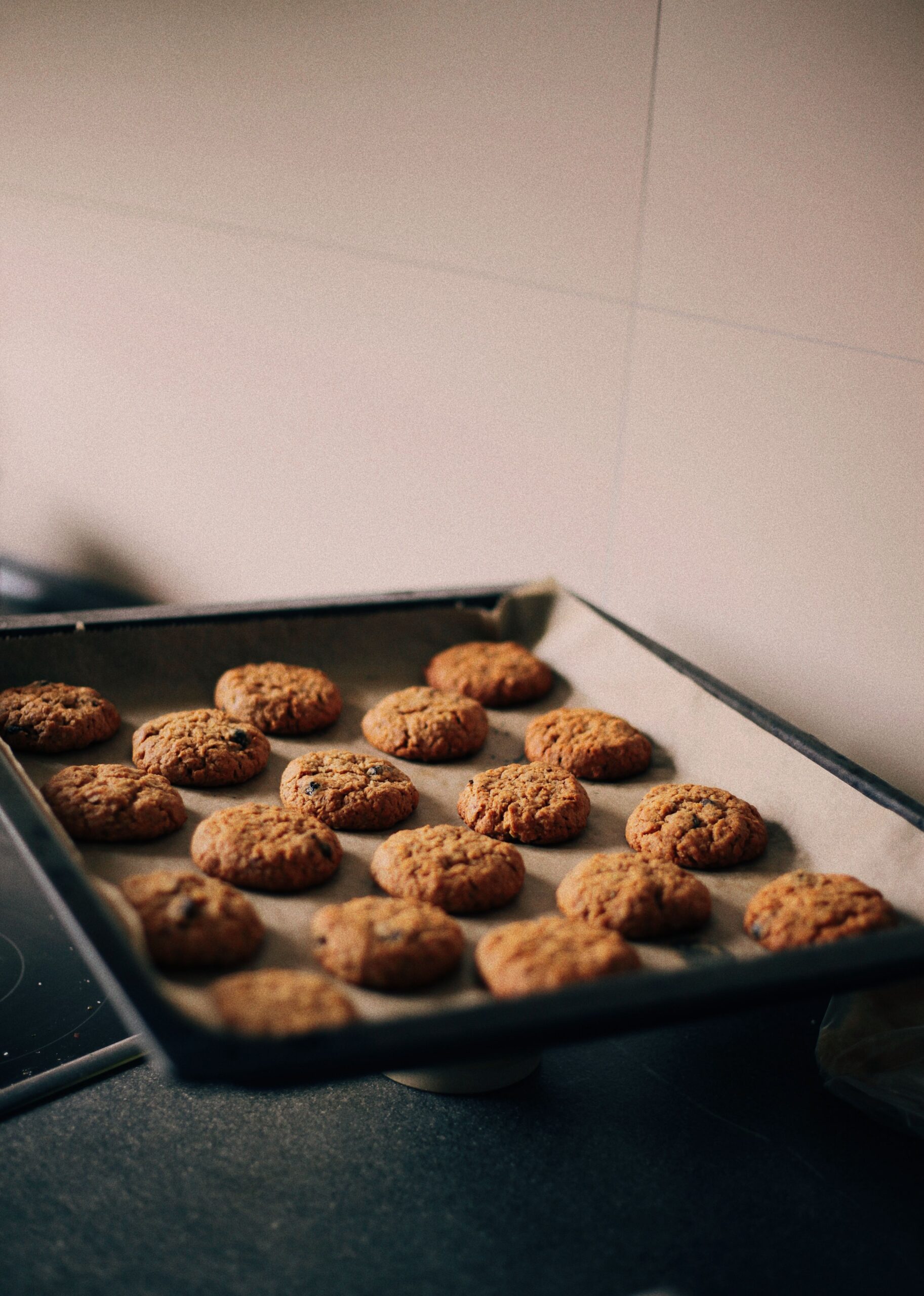
Weigh the flour. When cookies come out of the oven as the same domed lumps that went in, too much flour is the likeliest reason, and it is the one cause that stays invisible while the dough is being mixed. That rule holds for most drop cookies made from a recipe followed as written. It breaks in two places. First, when something in the recipe was changed, even slightly: less sugar, a different flour, a halved batch. Second, when the oven runs hotter than the dial claims. Both get covered below, along with the baking soda question almost everyone reaches for first. Cookies that refuse to spread are diagnosable from the finished cookie, and several causes are fixable with dough already mixed.
Rule Out the Leavener First, Then Stop Thinking About It
Baking soda is the first suspect in almost every kitchen. Cheap to replace, easy to blame, and a carton open since last winter looks guilty. Can old or expired baking soda cause cookies not to spread? It can. But the cookie it produces looks different from the one most people are standing over.
Spent leavener gives pale, slightly heavy cookies that hardly spread at all. It does not give tall puffy ones. Most of baking soda’s effect on spread runs through the dough’s pH rather than through gas, so a dead carton costs browning and the slackness a cookie needs to flow outward, not height. A batch that came out domed and cakey fits that picture too.
Test both anyway. Two minutes rules out a whole branch of the diagnosis.
- Baking soda: stir half a teaspoon into a tablespoon of white vinegar. Fresh soda fizzes on contact, and vigorously. A thin or delayed reaction means the carton is finished.
- Baking powder: stir half a teaspoon into two tablespoons of warm water. This one is milder than the vinegar test by design — clearly foaming, but without the violence. Judge it against that gentler standard, or good powder goes in the bin.
With both leaveners alive, the cause sits in one of four places: what went into the dough, how cold it was, how hot the oven and pan actually ran, or what got changed from the original recipe. What causes cookies to not spread while baking is nearly always one of those four, and the finished cookie points at which.
| What came out of the oven | Most likely cause | First move |
| Tall, cakey, pale, still scoop-shaped | Too much flour | Weigh it. 120g per cup of all-purpose. |
| Domed, small footprint | Dough went in too cold | Rest scooped dough 15–20 minutes. |
| Puffy and craggy, sinking as it cools | Too much powder, or powder where soda belonged | Check the recipe’s leavener against the bowl. |
| Set rims, underdone middle, barely spread | Oven running hot | Read the true temperature. |
| Some spread, some didn’t, same tray | Uneven dough temperature or an oven hot spot | Scoop the whole batch first. Rotate the sheet. |
| Drier and thicker than last time | A substitution, reduction, or scaled batch | Retrace the change. |
Weigh the Flour Before Changing Anything Else
Too much flour is the usual answer to why cookies come out thick and puffy instead of flat, and volume measuring is how it happens unnoticed. King Arthur puts a spooned and levelled cup of all-purpose at 120 grams. The same cup dipped into the bag and packed can hold up to 160. That is a third more per cup, so a two-cup recipe quietly gains 80 grams — two-thirds of an extra cup nobody added.
Flour is the ingredient that stops spread, so the mechanism is direct. A cookie holds its shape once the starch and protein have soaked up enough moisture to set a structure. Add more flour against the same fat and sugar and the dough goes stiffer, sets sooner, never relaxes outward. Can too much flour stop cookies from spreading? Comfortably, with nothing else at fault.
Wrong flour type arrives at the same place by another route. Bread flour carries more protein, builds more gluten, gives a taller chewier cookie. Whole wheat pulls in more liquid at the same weight, leaving less free to keep the dough fluid. Rye cuts both ways: a gram-for-gram swap to whole-grain rye can stop spread dead, while King Arthur found the finer medium grade did the opposite in drop cookies. Cake flour usually spreads more, being lower in protein. Egg size is a smaller version of the idea: large eggs swapped for medium costs several grams of liquid, and the dough stiffens by that much.
A digital kitchen scale removes the problem entirely. Without one: fluff the flour in its bag, spoon it loosely into the cup until it heaps, level with the back of a knife. Never dip the cup into the bag.
Check the Dough’s Temperature, Not the Butter’s
Does cold butter or cold dough prevent cookies from spreading? Both play a part, and the dough matters more than most troubleshooting lists suggest.
Butter gets most of the attention. Softened butter for creaming sits near 65°F, cool to the touch and giving under a finger without smearing. Colder than that will not cream properly, which tends toward a dense cookie rather than a tall one. The more common fault runs the other way: creaming for five minutes when the recipe asked for two whips air into the fat, and the cookie rises on that air instead of flowing outward. Cream until the mixture lightens, then stop. Over-mixing after the flour goes in does something similar, developing gluten the dough does not need.
Dough temperature is the bigger lever. Fat entering the oven near 35 to 40°F takes longer to melt, and the rim can set before enough has liquefied for anything to move. Cookies that didn’t spread after chilling dough overnight are behaving exactly as chilled dough behaves — the technique working, and a fault only when the recipe wanted a thin cookie.
How long should cold cookie dough sit at room temperature before baking? An hour or two of chilling usually needs 15 to 20 minutes back on the counter, already scooped. After an overnight chill, closer to 30. The scoops should give slightly under a thumb, not feel like stones. All of it depends on the kitchen: a 78°F room in August does in 10 minutes what a 65°F one does in 25.
Work Out Which Leavener the Recipe Is Leaning On
What’s the difference between baking soda and baking powder for cookie spread? Soda promotes spread. Powder promotes lift. Both release carbon dioxide, and that shared job matters least here.
Baking soda is a base with no acid attached. It needs an acidic ingredient already in the dough — the molasses in brown sugar, buttermilk, natural cocoa, honey. Reacting neutralises that acid and leaves the dough alkaline, and an alkaline dough behaves differently under heat. Gluten is weaker. Egg proteins coagulate more slowly. Browning runs faster. The dough stays fluid longer before it sets, and that fluid window is when a cookie spreads. Alkaline doughs spread more and brown more; acidic doughs spread less and stay paler.
Baking powder brings its own acid, so it leaves the pH where it found it. Structure sets on the original schedule and the gas goes into height instead. Does baking powder make cookies spread less than baking soda? At the same quantity, yes, and visibly. Swapping powder for soda reliably turns a thin chewy cookie into a domed cakey one.
That swap is often the answer to why cookies are cakey instead of spread out and chewy. Adding more powder makes it worse: past a point the bubbles grow unstable and collapse, leaving a cookie that is craggy and dense rather than light. Recipes calling for both run two jobs at once — soda for spread and colour, powder for structure. Cutting either changes the cookie’s shape, not only its height.
Test the Oven, Then Look at the Pan
Does oven temperature affect cookie spread? Substantially, and usually in the direction people do not expect. A hot oven sets the edges before the fat finishes melting, freezing the cookie roughly where it was scooped. The signature is a pale dome with a firm rim and an underdone middle.
Oven temperature accuracy drifts with age. A gap of 15 to 25°F between the dial and the cavity is ordinary, and wider ones are not rare. No built-in display reveals it — the display reports what the thermostat is aiming for, not what the air is doing. An oven thermometer on the middle rack, read after a full preheat, settles it in one bake. Preheat past the beep too: another ten minutes, since the beep marks the air reaching temperature, not the oven walls. The same drift sits behind failures that look unrelated, like a cake that shrinks after baking.
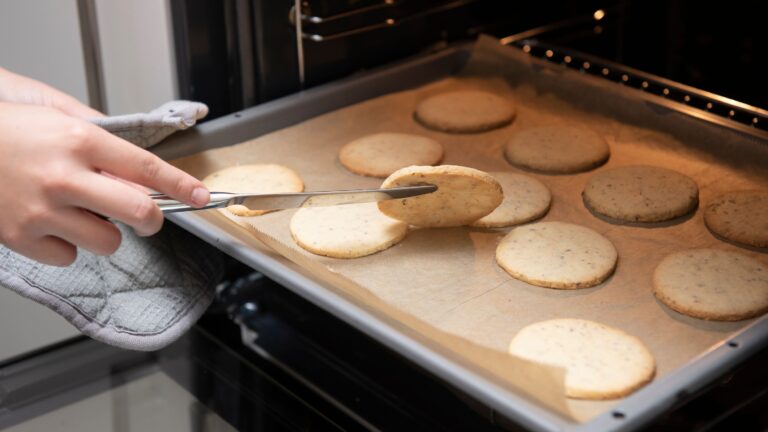
Rack position belongs in the same conversation. Middle rack for cookies — hot air gathers at the top of the oven, so a tray up there browns before the dough has had time to move. Pan colour shifts the numbers again: dark sheets absorb more radiant heat and run hotter than light aluminum, setting the base faster. Dropping the oven about 25°F compensates. A greased sheet tends to give a little more spread than parchment.
Why did some cookies on the tray spread and others didn’t? Two causes, easily separated. Spread ones clustered along one side means an oven hot spot; rotating the tray halfway through fixes it. Scattered with no pattern means the dough was at different temperatures when scooped — the first few off a warmer bowl, or some onto a sheet still hot from the last batch. Scoop the whole batch before the first tray goes in, and cool sheets between batches. An overcrowded baking sheet does a milder version. Two inches between scoops.
Humidity is the variable nobody controls. Flour picks up moisture from damp air, so a familiar recipe varies with the season — usually toward slightly more spread, not less.
Retrace Whatever Changed in the Recipe
Dough that spread fine last time and does not now points at a change rather than a fault. It is the most under-diagnosed cause on the list, because the change nearly always felt harmless.
Reducing sugar is the big one. Sugar does more than sweeten: granulated sugar liquefies in the oven, and that liquid is much of what carries a cookie outward. Cut it by a quarter and the dough loses a quarter of its spreading agent. What’s the right sugar ratio to help cookies spread more? No universal figure exists, since it varies with the fat and flour around it, but the direction is usable. At a fixed total weight, shifting toward white granulated and away from brown gives more spread and crisper edges — brown sugar holds moisture and pulls the cookie toward thick and chewy. Converting a recipe to all brown sugar costs spread.
Cutting the fat works the same way from the other side, fat being the medium the dough travels in. Mix-ins matter more than they look: one cup of chocolate chips is fine, but three cups of chips, nuts and marshmallows is more solid than dough, and the solids block the flow. Loaded cookies spread less, so scoop them smaller.
Scaling goes wrong most often, and halving is worse than doubling. One egg halved by eye is rarely a true half, and short liquid stiffens everything. Beat the egg, weigh it, take half. Doubling causes less trouble, though creaming time does not scale with quantity and a big batch is easy to over-aerate.
One honest exception. Why didn’t my sugar cookies spread is often not a problem at all — plenty of sugar cookie recipes are built specifically not to spread, so cut-out shapes keep their edges. Nothing here applies unless the recipe was meant to give a thin cookie. The opposite complaint, cookies that spread too much, runs on a different cause list.
Fix the Dough That’s Already Mixed
How do I fix cookie dough that won’t spread after chilling? Bake one cookie alone before committing a full tray. Ten minutes shows exactly what the batch will do, which beats guessing at a fix and losing all thirty.
1. Rest it. Scooped dough sitting out 15 to 30 minutes, depending how long it was chilled, solves the cold-dough version completely, and adds nothing to the recipe.
2. Still domed? Work in up to a tablespoon of milk or melted butter per two cups of flour, a teaspoon at a time. Milk adds slack; melted butter adds slack and spread.
3. Flatten the scoops. Press each ball to roughly two-thirds of its height with the base of a glass. No chemistry changes, but it hands the cookie a head start on a shape it cannot reach alone.
4. Try tapping the pan. Pull the sheet out once the cookies have puffed, drop it flat onto the rack, slide it back. The impact knocks air out and forces spread. Twice more, letting them puff again between drops, gives the rippled edge.
5. Remake it on a scale if there is time. Dough carrying 80 extra grams of flour can be loosened, but loosening won’t fix the ratio underneath.
For the next batch: weigh the flour at 120 grams per cup, give the scooped dough 20 minutes on the counter, and bake one cookie before the rest of the tray goes in.