Cakes Fall When Cooling Because the Crumb Never Set
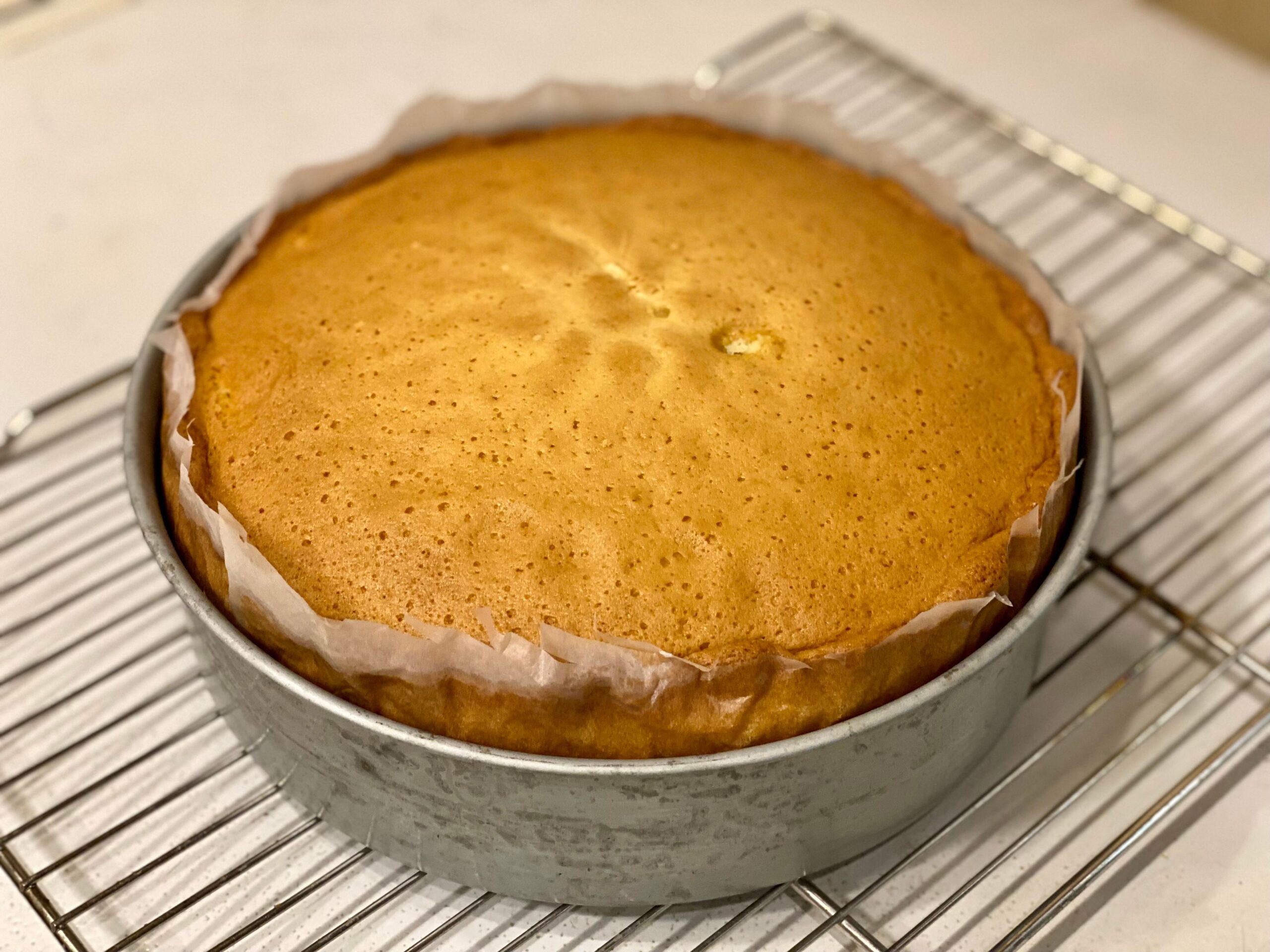
You lift the tin out, set it on the rack, and by the time the kettle boils the middle has dropped into a crater. The cake didn’t fall while it was cooling. It failed in the oven, and cooling is only when you found out. A hot cake is held open from the inside: steam and carbon dioxide are still pushing outward, and they will prop up a crumb that has no business standing yet. Cooling takes that support away.
What’s left is whatever the flour starch and the egg proteins built while the heat was on. Set fully, and nothing happens on the rack. Set halfway, and the walls fold the moment the pressure drops. So the fix almost never lives on your counter. It lives about twenty minutes further back.
Cooling Doesn’t Break a Cake, It Tests the One You Baked
Ask why do cakes fall when cooling and three answers arrive at once, all pulling the same way. Steam trapped in the crumb condenses back to water, so the vapor inflating each cell vanishes. The carbon dioxide left over from the baking powder contracts as its temperature drops. And the coagulated egg proteins tighten and pull inward, which is the same shrinkage that leaves an angel food cake squat and rubbery if it cools right side up.
A finished crumb takes all of that without moving. Its starch granules have swollen and gelatinized, and the egg and flour proteins have bonded into a network around them. That protein network is what holds the crumb up as it cools. The starch gel sets later, on the rack, firming the texture rather than saving it. An unfinished crumb is batter wearing a cake’s clothes. It has the dome, the color and the crust, and none of the strength.
For most butter cakes that finishing point sits between 200°F and 210°F at the center, though the exact figure varies with the formula. A dense pound cake and an airy sponge don’t finish in the same place. Which is why a thermometer reading is a useful input for cake and a bad verdict on its own.
The Shape of the Collapse Tells You Which Cause You Have
Cakes don’t sink in one generic way. The crater has a shape, the crumb has a texture, and the timing narrows the field.
| What you saw | What it means | What to change |
| Sank within a minute of coming out, wet band through the middle | Underbaked center, starch never set | Bake longer, confirm with three cues not one |
| Rose tall, sank in the oven, big irregular holes, soapy taste | Too much baking powder or soda | Level-measure or weigh it, cut by a quarter |
| Coarse tunneled crumb, rubbery near the dip | Overmixed once the flour went in | Fold to just combined, stop while streaks show |
| Cracked over-domed top, dark edges, sunken middle | Oven running hot, crust set first | Check the real temperature, drop it 25°F |
| Batter filled the tin near the rim, then sagged | Pan too small for the batter | Fill halfway to two-thirds, bake the rest apart |
| Angel food or chiffon, squat and dense throughout | Cooled the right way up | Invert onto its feet or a bottle neck at once |
If the cake looked correct coming out and only fell on the rack, start at the first row. It probably accounts for more sunken cakes than the other five together.
Underbaking Is the Likeliest Answer, and a Clean Toothpick Won’t Rule It Out
The toothpick test has a real failure mode. Probe through a melted chocolate chip or a soft piece of fruit and the skewer comes out slick rather than wet, which reads as clean. Probe half an inch off center in a 9-inch tin and you’re testing crumb that set several minutes before the middle did. One test, one spot, one chance to be wrong.
Use three signals together and pull the cake only when they agree. The edges should have shrunk away from the tin by a millimeter or two. The top should spring back and leave no dent. And an instant-read thermometer pushed into the deepest part of the center, clear of the base, should read inside that 200°F to 210°F band. Nudge the tin as well. A set cake quivers at the surface; an underbaked one moves in the middle like a single soft mass.
Oven temperature accuracy is what most of these cakes come down to, and the dial is not evidence. An oven thermometer settles it permanently. Give the oven 12 to 15 minutes past the preheat beep before anything goes in, because the beep tends to mean the air is hot rather than the walls. On convection, the fan browns the top well ahead of the center, so drop the setting 25°F when you convert a conventional recipe.
Cold ingredients work against you too. Fridge-cold butter won’t hold air during creaming, and a cold batter takes longer to reach setting temperature, which pushes the bake past the time the recipe promised. Room-temperature ingredients are worth the wait. Eggs and milk shed the chill in about half an hour, but a whole stick of butter wants closer to two hours on the counter to come down to the 65°F that creams properly, or ten to fifteen minutes in a bowl of barely warm water with the wrapper still on. In a large tin, a flower nail stood upright in the greased pan can conduct heat inward and narrow the gap between when the edges finish and when the middle does.
The oven door gets blamed more often than it deserves. Opening it early does dump heat, so keep it shut until three-quarters of the bake has passed. But a door opened once at 40 minutes doesn’t always sink a properly baked cake. If yours falls every time, the door isn’t your problem.
Too Much Leavening Breaks the Cells Before the Cake Leaves the Oven
Baking powder doesn’t fail by making more gas than the batter can hold. It fails by making that gas faster than the walls can stretch. Cells inflate past their limit, rupture, and merge into fewer, larger voids, and a foam of a few big bubbles has nothing like the strength of a foam of many small ones. The giveaway is timing: this cake peaks early and drops while it is still in the oven. Taste it and you may find something faintly bitter or soapy, which is unneutralized baking soda.
A quarter teaspoon of extra baking powder can be enough to matter in an 8-inch layer. Scooping straight from the tin packs it, so spoon it in and level the top with a knife, or weigh it. If a recipe has sunk on you twice, cut the powder by a quarter and see what the third bake does.
Old leavening produces the opposite failure, which matters so you don’t chase the wrong fault. An expired tin gives a flat, close, heavy cake rather than a crater. Drop half a teaspoon of baking soda into vinegar and it should erupt at once. Baking powder goes into hot water and should bubble steadily across a few seconds rather than explode. Gentler is normal for powder, so don’t bin a good tin on that test.
Two habits weaken cell walls the same way. Creaming butter and sugar on high for six or seven minutes whips in large, unstable bubbles that pop under heat, where three minutes at medium is enough. Beating on after the flour goes in builds gluten structure a cake doesn’t want, and the batter consistency turns from thick and pourable to elastic and stringy. That is your cue to stop. A batter generous with sugar and fat also sets later and softer than intended. An extra spoon of sugar for flavor is a structural change, not a seasoning one, and the same reasoning explains why does my cake shrink after baking.
Above 3,000 Feet the Recipe Is Wrong, Not Your Technique
Atmospheric pressure runs 14.7 pounds per square inch at sea level and 12.3 at 5,000 feet. Leavening gas expands further against that thinner air before the batter is firm enough to contain it, so cells stretch coarse or tear and the cake drops. Water boils at 203°F up there too, which speeds evaporation and concentrates the sugar left behind. It also puts a ceiling on that 200°F to 210°F doneness band: at 5,000 feet a cake center will not climb much past 203°F, so lean on the spring back and the shrink-away rather than the thermometer. Most sea-level recipes hold to about 3,000 feet. Past that, the numbers need moving, though the published adjustment table below only begins at 3,500.
| Adjustment | 3,500–6,500 ft | 6,500–8,500 ft | 8,500–10,000 ft |
| Baking powder, per tsp: reduce by | 1/8 tsp | 1/8–1/4 tsp | 1/4 tsp |
| Sugar, per cup: reduce by | 0–1 Tbsp | 0–2 Tbsp | 1–3 Tbsp |
| Liquid, per cup: add | 1–2 Tbsp | 2–4 Tbsp | 3–4 Tbsp |
Raise the oven 15°F to 25°F alongside those changes. A hotter oven sets the batter sooner, before the gas cells over-expand, and it usually shortens the bake, so start checking early. Rich cakes may also need a tablespoon or two less shortening and one extra egg, trading tenderness for the protein that holds the crumb up. Angel food and sponge want less sugar, more flour and a higher temperature, with the whites whipped only to peaks that droop at the tip. Stiff, dry whites collapse. Change one variable per bake, and try the recipe unmodified first. Plenty survive altitude.
These Common Questions Come Up After Every Sunken Cake
What should I do if my cake falls when cooling?
Leave it alone until it is completely cold, because warm crumb tears. Level the raised rim with a serrated knife or a cake leveler, then decide whether it becomes a filled cake, a trifle or crumbs. For troubleshooting, write down when it dropped, how the middle felt and how it tasted.
Can you put a sunken cake back in the oven?
Not with much chance. Once the crumb has cooled, the gas cells that gave it lift are gone, and reheating won’t re-inflate them. You get a drier cake with the same crater. Catch it with a raw center while it is still hot, or at least warm, and returning it can work. Otherwise, salvage it.
How do you fix a cake that sinks in the middle?
Level it rather than fill it when the dip is shallow: trim the high edges to the low point and you have a flat layer nobody questions. For a deeper crater, cut the sunken section out and pack the cavity with jam, curd or buttercream before the next layer goes on.
What can you do with a sunken cake?
Trifle is the best use for a dense, heavy middle, since custard and cream hide texture frosting cannot. Cubed with syrup and fruit it disappears entirely. Firmer sunken cake blends with frosting into cake pops, or goes into a bowl with ice cream. None of that needs a level crumb. Cut away anything still wet enough to read as batter first, though — that part needs baking, not custard.
Will a sunken cake taste OK?
Usually, with two exceptions. A raw, gummy center from underbaking tastes of flour and won’t improve, and if it is wet enough to still be batter it shouldn’t be eaten at all: uncooked flour and raw egg both carry a real risk of food poisoning. A cake that collapsed from excess baking soda carries a soapy edge you notice on the second bite. Everything else is a texture problem rather than a flavor one.
Why does the middle of my cupcakes sink?
Overfilled liners are the usual reason. Batter above two-thirds rises past what the paper supports, then falls back. Excess leavening does it too, and cupcakes show that fault earlier than layers because they set fast. Check oven temperature as well, since hot spots hit a tray of 12 unevenly.
Can a cake sink even if it isn’t underbaked?
Yes, and this is the case worth understanding. A fully baked cake still falls if its cell structure broke before it set: too much leavening, aggressive creaming, or more sugar and fat than the flour and eggs can support. The crumb comes out dry rather than gummy. That is the tell.
Are there specific types of cakes more prone to falling?
Foam cakes are most fragile. Angel food, chiffon and sponge lean on whipped egg white rather than starch, so they have to cool inverted. Rich cakes high in sugar and butter come next, because both delay the set. Sturdy butter and pound cakes are the most forgiving.
How does humidity impact cake baking and cooling?
Flour absorbs moisture from damp air, so a cup measured in humid weather holds less flour than the same cup in winter, which weakens structure. Weighing removes most of the variation, though flour that has already absorbed moisture carries it onto the scale. Cooling drafts matter less than people assume, unless the cake sits under an air-conditioning vent.
Run This List Before the Next Cake Goes In
- Oven thermometer on the middle rack, and 12 to 15 minutes of preheat past the beep
- Eggs and milk out of the fridge half an hour ahead, butter closer to two hours
- Leavening spooned and leveled or weighed, never scooped, and in date
- Butter and sugar creamed three minutes at medium, not six on high
- Flour folded in by hand, stopped while it looks a touch undermixed
- Tin filled halfway to two-thirds, any excess baked separately
- Door shut until three-quarters of the stated bake time has gone
- Three cues agreeing before it comes out: edges shrunk away, top springing back, center at 200°F to 210°F
- Above 3,000 feet, adjust the recipe before you change your technique
- Cooled in the tin for the time the recipe gives, then onto a rack, and not frosted until cold another half hour
If the next one still sinks, the recipe is the variable left standing. Weigh everything, bake it once more as written, and if it fails again, change recipes rather than technique. A dense but level cake is a different fault, covered in how to fix dense cake after baking.