How Long Bread Should Sit After Baking: 30 Minutes to 24 Hours
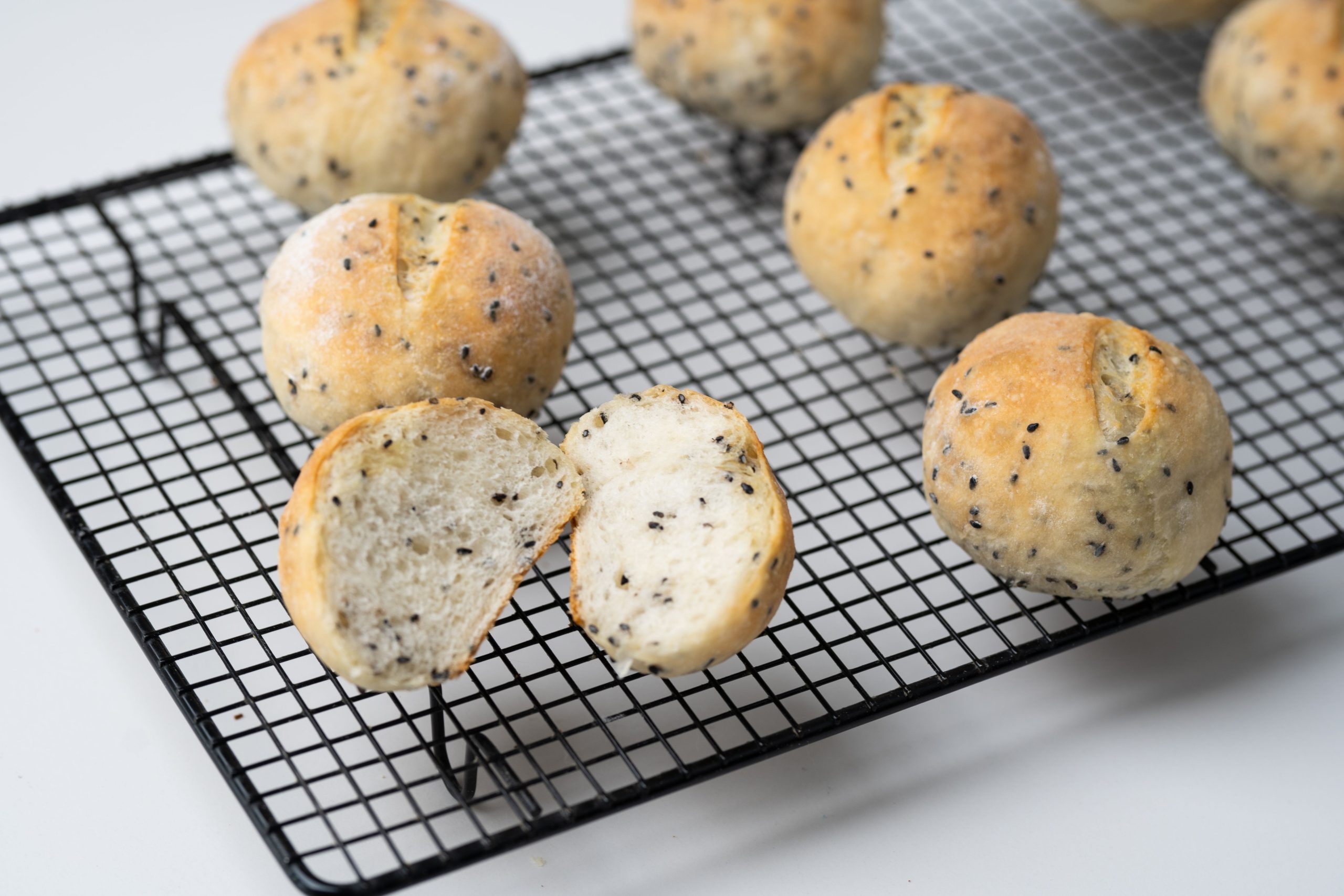
The crust lies to you. Forty minutes out of the oven, a sourdough boule feels ready. The outside is barely warm, the knife is right there. Push a probe into the middle and you’ll get something near 150°F. That center is still a hot starch gel, still setting. So the honest answer to how long bread should sit after baking is: long enough for the inside to finish, which runs well past the point where the outside feels cool. Most yeasted loaves want about two hours. Rolls are done in thirty to forty-five minutes. A 100% rye loaf wants twenty-four, and eats better at forty-eight.
Your loaf is still baking after it leaves the oven
Bread comes out of a hot oven with its center around 200°F, and residual heat keeps pushing that up for a few more minutes. Usually 3 to 10°F, more in a big loaf. That’s carryover cooking, the same effect that makes you pull a roast early. The bake doesn’t stop when the timer does.
Two separate processes run during the cool-down, and both of them need the loaf left in one piece.
The first is starch retrogradation. During the bake, starch granules soak up water, swell, and turn into a soft gel — gelatinization. As the crumb drops below roughly 140°F, the amylose in that gel begins re-crystallizing into an ordered structure, which turns a hot mash into something a knife passes through cleanly. Amylopectin, the other starch fraction, re-crystallizes far more slowly over the following days, and that slow version is staling. Same chemistry, different clock. It also explains why bread goes hard after cooling: the set that made it sliceable keeps going.
The second is moisture redistribution. Steam trapped in the hot center migrates outward toward the drier crust, and the crumb stops feeling wet. Some of the crust’s crackle goes in exchange.
That’s the mechanical answer to why bread needs to rest after baking. Cut early and you’re dragging a serrated blade through an unset gel, compressing air pockets it took all day to build.
How long should bread sit after baking, by type?
These are starting points, not laws. Read the table, then confirm with the temperature checks in the next section.
| Bread type | Out of the pan | Wait before slicing | Why this number |
| Dinner rolls, baguettes | Straight onto a rack | 30–45 min | Mostly crust, little mass to set |
| Sandwich loaf (enriched, pan-baked) | After 10 min in the pan | 1½–2 hr | Fat-rich crumb; the pan traps steam underneath |
| Enriched sweet bread (brioche, babka, challah) | After 10 min in the pan | 1½–2 hr | Butter and egg set as it cools; fragile warm |
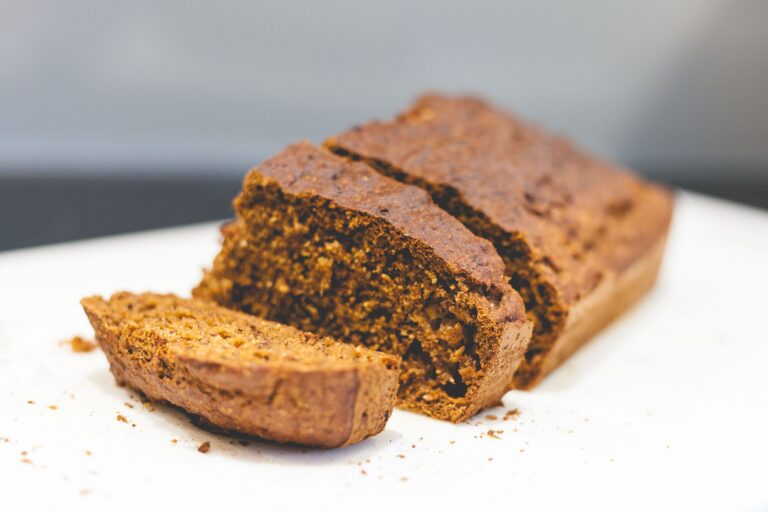
| Quick bread (banana, soda bread) | After 15 min in the pan | 1–2 hr | Minimal gluten network, so set starch is the structure |
| Artisan boule or batard, white flour | Straight onto a rack | 2–3 hr | 800g of crumb at 205°F holds heat for hours |
| Sourdough, 75%+ hydration | Straight onto a rack | 2–4 hr | More water means more steam to move outward |
| Whole grain or 50% rye | Straight onto a rack | 4–6 hr | Bran and pentosans hold water tightly |
| 100% rye | Straight onto a rack | 24 hr minimum | Pentosan gel sets slowly; flavor improves to 48 hr |
You’ve probably noticed that published charts disagree, sometimes wildly. One site puts sourdough at an hour, the next at six. They’re describing different loaves. Three variables set the real number: mass, hydration and flour. A 500g batard holds less heat than a 1.2kg boule and has more surface relative to its mass to lose it through, so the small loaf wins twice. An 85% sourdough carries far more water than a 65% sandwich dough. Almost nobody publishes those variables beside their numbers, which is how the spread got so wide.
Rye earns its outlier status. Rye flour has no useful gluten, so structure comes from pentosans, plant gums that hold something like eight to ten times their own weight in water. That gel is still firming up hours after the loaf stops feeling hot. How long to let rye bread cool is a different question from how long to cool anything else: Jeffrey Hamelman’s Bread puts 60% rye loaves at a full day’s rest and 100% rye at 48 to 72 hours. Slice a rye at thirty minutes and you get a wet, claggy cut face and flavor that hasn’t arrived.
Temperature is a better signal than the timer
Every number above is a proxy for internal temperature. So what temperature should bread be before slicing? Under 100°F for a crusty loaf, measured at the center. Above roughly 150°F is where the gummy cut face starts, and between the two it’s a gradient. Soft rolls and sandwich bread you plan to bag can go in around 95°F: if the crumb feels neither warm nor cool against your wrist, you’re there.
Measure with an instant-read thermometer, and push the probe in through the side of the loaf, aiming for the middle. Enter from the top and the hole shows up in your best slices.
Without a thermometer, run this sensory checklist. It’s how to tell when bread is done cooling:
- Check the base, not the top. Cup the bottom crust in your palm — it’s the last part to release heat, and a warm base means the middle is warmer still.
- Lift it. A cooled loaf feels lighter and emptier than it did leaving the oven, because a fair amount of water has left as steam.
- Listen for the crackle. Crusty loaves tick and pop for the first ten to twenty minutes as the crust contracts. Once it’s quiet, the fast phase is over.
- Try a test slice at the heel end. If the blade comes away tacky and crumb-coated, set it down for another thirty minutes.
- Feel for softening. A crust gone from glass-crisp to merely firm is telling you moisture has reached it from inside, which means the interior has drained.
Your kitchen moves all of this. A 62°F room in February cools a boule considerably faster than an 80°F one in August, and a loaf parked on the stovetop above a still-hot oven barely cools at all. Every range here assumes a rack, a room near 70°F, and nothing draped over the loaf.
Troubleshooting: what goes wrong when you cut bread warm?
Can you cut bread while it’s still warm? You can, and sometimes you should — warm rolls with butter are one of the better reasons to bake. Just know what you’re trading. The cut face turns tacky and sticks to the knife. Slices compress instead of springing back. Crumb tears rather than parting. And the loaf stales faster: cutting early for the steam show lets that steam bolt out instead of redistributing, which leaves a loaf gummy at the cut and dry two inches in.
This is where most people ask why is my bread gummy after baking and get an answer that doesn’t fit their loaf. Start from the symptom. There are two versions — one gummy at the cut, one dense and damp all through — they look nearly identical, and they have opposite fixes.
Type one is cut-too-early gumminess. The loaf was fully baked: a lean dough that reached 200 to 210°F, an enriched one 185 to 190°F. Gumminess sits at and near the cut surface, and the rest of the loaf improves over the next hour. Rebaking won’t help — the damage was done by the knife, not the oven, so the only fix is prevention on the next loaf. Toast the sticky slices.
Type two is underbaking, and undercooked bread is often the real diagnosis. The center never reached its doneness temperature, under about 200°F for a lean loaf or 185°F for an enriched one, so the texture reads dense and compressed through the middle of every slice, often as a damp band near the base. This one is fixable. Put the loaf back into a 350°F oven for 10 to 20 minutes, tented with foil if the crust is already dark. It works even on a fully cooled loaf. If the center is raw rather than damp, cut your losses.
The diagnostic question is where the gumminess sits: at the cut face only, or through the middle of every slice. Sourdough gets accused of type one constantly and usually deserves it. High hydration, a heavy crumb and a 450°F Dutch oven bake add up to a loaf that reads cool outside while its center is still near 150°F, which is exactly why sourdough turns gummy when cut too early. Give it two to four hours, not the standard hour people apply to a supermarket loaf. Cakes fall into the same trap: a sticky cake is very often this same problem, cut before the crumb had finished setting.
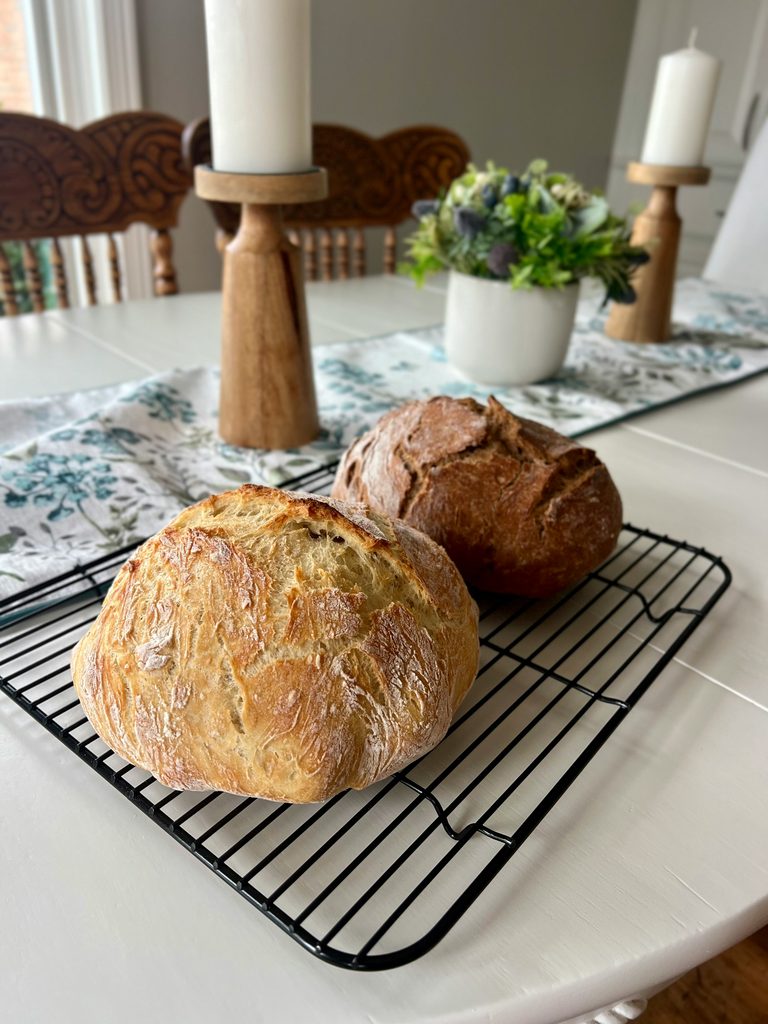
How to cool a loaf so the crumb sets properly
The method matters as much as the wait. Six steps:
- Get it out of the pan. Free-form loaves go straight onto a rack. Pan loaves get 10 minutes to firm up at the edges, then come out — leave one in longer and steam collects underneath, softening the base into a soggy bottom. Quick breads want 15.
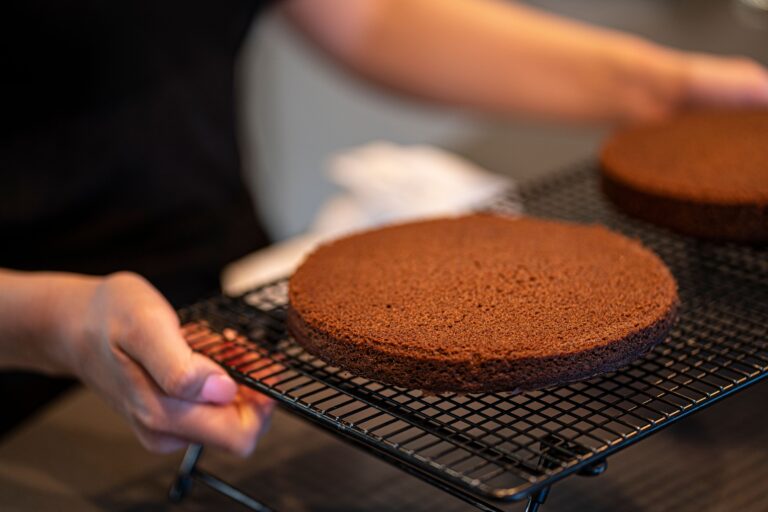
- Set it on a wire cooling rack. Air has to reach the underside. A loaf on a solid board is steaming its own base for the next two hours.
- Leave it uncovered. No towel, no bag: a cover over a hot loaf traps escaping moisture, which condenses on the crust and softens it. Soft dinner rolls are the exception, where a light cloth buys you a tender top.
- No rack? Balance the loaf on its side against something solid so the base isn’t touching the counter. That works for round loaves and poorly for pan loaves, which still have a flat face making contact. Two chopsticks underneath work too.
- Don’t halve the loaf to speed things up. It does cool faster, and it defeats the purpose, because you’ve exposed the crumb before it set. A small fan pointed at the rack is the legitimate shortcut.
- Bag or wrap only once the center is under 100°F. Wrapping warm bread is the most common way to ruin a good crust, and it can turn the base gummy overnight.
The best way to store bread after cooling depends on the crust you want to keep. Crusty loaves do well cut-side-down on a board, in a paper bag, or in a bread box — anything breathable. Soft sandwich bread goes in a plastic bag and keeps at room temperature for up to 4 days. Quick breads are a different case again — a banana loaf wants to be sealed, not breathing, and the fridge works against it. Skip the fridge; 35 to 40°F is where amylopectin re-crystallizes fastest, so refrigerated bread stales quicker than bread on the counter. For anything you won’t finish in a few days, slice it cooled, freeze in a sealed bag, and toast straight from frozen.
Loose ends worth knowing
Can I leave fresh baked bread on the counter overnight?
Yes, and for a loaf out of the oven late at night that’s the right call. Leave it uncovered on a rack until morning. The crust protects the crumb well enough alone, and one gone slightly leathery overnight comes back with five minutes in a 400°F oven. If you want to bag it and can’t wait up, give it two hours out first.
Is bread sliced before or after it is baked?
After, always. Slicing raw dough would collapse the gas structure the loaf needs to rise. What you may be thinking of is scoring: the shallow slashes cut into a shaped loaf just before it bakes, which control where the crust splits. Commercial pre-sliced bread is blade-cut after cooling. Firm crumb slices, soft crumb smears.
How do bakers slice freshly baked bread?
Mostly they don’t. Professional loaves are sliced cold, after a full cool-down, because the crumb cuts cleanly and holds its shape. When a loaf has to be cut straight out of the oven, the method is a long serrated bread knife, a slow sawing action, no downward pressure, and a wipe of the blade between slices — warm starch gums the teeth and drags. Pressing flattens a warm crumb into a dense strip.
Can you speed up bread cooling?
A little. A fan on low aimed across the rack pulls warm air off the crust and can take a real bite out of a two-hour wait. Splitting the loaf, the fridge, or the air conditioner cool the outside fast and do little for the center, and the fridge adds condensation. Nothing gets a 1kg sourdough sliceable in twenty minutes. Bake earlier instead. Planning the timing is the fix for most cooling problems, cakes included.
The one number to act on
Of everything on this page, internal temperature does the most work. Bread type gives you a ballpark and the crackle tells you roughly where you are, but a probe pushed in through the side ends the argument in three seconds. Wait for it to read under 100°F, then cut. On a 900g sourdough in a 70°F kitchen that lands near the three-hour mark, about an hour after the crust stops feeling warm and you’ve started reaching for the knife.